The Da Nang–Hội An coastal corridor is Vietnam's most exciting luxury hotel market. We rank the best resorts from Son Tra Peninsula to Cua Dai beach for 2026.
The 30km coastline between Da Nang and Hội An has undergone a transformation since 2015 that has made it one of Southeast Asia's most compelling luxury hotel destinations. The combination of My Khe Beach's accessible city shoreline, the sculptural drama of Bà Nà Hills, the UNESCO heritage of Hội An old town, and the culinary depth of central Vietnamese cuisine makes the corridor uniquely compelling for luxury travellers.
Why Da Nang & Hội An for Luxury Travel?
Central Vietnam's culinary identity: This region gave the world bánh mì, cao lầu (a Hội An noodle dish available nowhere else), and mì Quảng. The food culture here is distinct from both northern Vietnamese and Saigon cuisines — more complex, more aromatic. For food-focused travellers, central Vietnam is the country's highest-reward destination.
UNESCO World Heritage proximity: Hội An Ancient Town is 30km from Da Nang city centre and 5km from Cua Dai Beach. Most coastal resorts offer shuttle service to the old town. No destination in Southeast Asia combines beach resort luxury with immediate access to a UNESCO World Heritage site quite like this.
Investment in infrastructure: Da Nang International Airport now handles direct routes from Singapore, Bangkok, Seoul, Tokyo, Taipei, Hong Kong, and multiple Chinese cities. The airport has been expanded twice since 2015 with further capacity coming online in 2026–2027.
Year-round considerations: Central Vietnam's weather differs significantly from the north and south. The dry season runs February–August (best swimming conditions, clearest skies). September–November brings the northeast monsoon — heavy rain, potential typhoon risk. December–January is cool by Vietnamese standards (18–22°C) but generally manageable.
Top Luxury Resorts: Da Nang to Hội An
1. InterContinental Danang Sun Peninsula Resort
The benchmark property for the entire corridor — consistently voted among Asia's finest resort hotels. The InterContinental Sun Peninsula occupies a private peninsula on the Sơn Trà (Monkey Mountain) nature reserve, accessible only by private funicular from the lobby to the beach.
Design: Bill Bensley, the architect who designed some of Asia's most recognisable hotels, created a property that rises through the jungle canopy across multiple levels. Restaurants, villas, and facilities are connected by pathways through a UNESCO-protected tropical forest.
Room highlights: HARNN Heritage Spa Suites with private rainforest gardens; Bà Nà Hills hilltop villas with panoramic sea views; beach villas at the base of the private peninsula with direct sea access.
Standout experience: Citron restaurant — part of the resort's multi-level dining concept — offers one of Vietnam's most impressive views alongside serious modern Vietnamese cuisine. The private beach at the base of the peninsula is accessible only to hotel guests.
Wildlife: The Sơn Trà nature reserve is home to a remaining population of red-shanked douc langur (among Vietnam's most beautiful primates). Dawn walks with the resort's naturalist guide make this experience genuinely rare.
Rate range: USD 500–2,500/night
2. Fusion Maia Resort Da Nang
Fusion Maia took a genuine risk with its core model when it opened: all-inclusive spa. Every Fusion Maia guest receives unlimited spa treatments throughout their stay — no booking fees, no à la carte charges for the standard treatment menu.
What this means in practice: At a typical 5-night stay, guests average 8–12 treatments. The spa team — 50+ therapists — works across a facility purpose-built at the resort's heart. Traditional Vietnamese therapies (Hội An silk treatments, green tea rituals, regional herbal compresses) are core to the program.
Room highlights: Pool villas only — every room has its own private pool. The smallest villas (Garden Pool Villa) are 180 sqm. The beachfront villas with direct sand access are among Da Nang's most photographed accommodation.
For couples and wellness travellers: Fusion Maia is frequently cited as one of Southeast Asia's best honeymoon properties — the combination of private pool villa, unlimited spa access, and proximity to Hội An creates a stay structure that genuinely relaxes.
Rate range: USD 350–900/night all-spa-inclusive
3. Four Seasons Resort The Nam Hai, Hội An
The Nam Hai sits 5km from Hội An on Cua Dai Beach — now under Four Seasons management and operating at the brand's consistent global standard. The resort's pool-villa layout along 1.1km of private beach is the gold standard for Vietnamese coastal luxury.
Room highlights: 100 pool villas across three tiers — hillside villas with garden privacy, beach villas with direct sand access, and the original colonial Great House estate with butler-attended private dining. All villas have private pools; beachfront villas open directly onto the sand.
Standout feature: The three-tiered infinity pool complex — cascading from the hilltop estate to the beach — is one of Vietnam's most recognisable pool designs. The main pool faces west; the sunset from the top tier, with the Thu Bon River estuary visible behind Cua Dai, is consistently spectacular.
Culinary: The Heart of the Earth restaurant serves modern Vietnamese with ingredients sourced from the resort's organic farm and surrounding Quảng Nam province. The resort's market tour to Hội An central market (with the chef) is one of the best hotel culinary experiences in Vietnam.
Rate range: USD 650–3,500/night
4. Naman Retreat
Naman occupies a quieter stretch of Non Nuoc Beach — south of the crowded Da Nang My Khe beach zone but north of the Hội An cluster. It was designed by Vietnamese architect Võ Trọng Nghĩa, whose bamboo architecture has won international recognition, and the property remains one of Vietnam's most architecturally distinctive resort environments.
Design philosophy: Bamboo as structural and aesthetic material — the restaurant, pool pavilions, and lobby all use Nghĩa's signature bamboo construction techniques. The result is a resort that feels rooted in Vietnamese landscape design rather than imported luxury.
Room highlights: Bamboo villas and garden pool villas; the Haven Villas (two-bedroom family configuration); premium beach-access rooms in the main building. The pool at Naman is the longest in Da Nang — 200m.
For active travellers: Naman's location between Da Nang and Hội An makes it the most practical base for cycling (the Hội An cycling path runs along the coast), surfing (Non Nuoc Beach is Da Nang's best surf break, October–March), and exploring both cities without long hotel transfers.
Rate range: USD 180–550/night
5. Hyatt Regency Danang Resort and Spa
For those who want luxury infrastructure plus direct city access, the Hyatt Regency on My Khe Beach delivers. It sits on the best-located stretch of Da Nang's main city beach — 15 minutes from the airport, 10 minutes from the Han River bridge, 30 minutes from Hội An.
Room highlights: Ocean-facing rooms with floor-to-ceiling glass; Pool Terrace Rooms with garden-level plunge pools; the Regency Club level with private lounge and dedicated check-in.
Standout feature: 5 pools including a lazy river (rare in Vietnamese luxury hotels), making it one of the most family-capable luxury properties on the corridor. The beach position on My Khe — consistently rated among Asia's best city beaches — is unmatched for direct sea access.
Rate range: USD 200–600/night
Exploring the Corridor
Hội An Ancient Town
The best-preserved trading port in Southeast Asia — 15th–19th century Chinese, Japanese, Dutch, and Vietnamese architecture in a UNESCO-protected area of 1km². No motorised vehicles in the heritage zone. The town is best experienced at 7am (before tour groups arrive) or after 9pm (when the lantern-lit evening atmosphere returns).
Full UNESCO listing and conservation information: Hội An Ancient Town UNESCO
Mỹ Sơn Sanctuary
Often overlooked by beach-focused tourists, Mỹ Sơn is a complex of Hindu temple ruins built by the Champa kingdom between the 4th and 14th centuries — contemporary with Angkor Wat in architectural period. Located 40km from Hội An. Half-day tour available from most resorts.
UNESCO listing: Mỹ Sơn Sanctuary UNESCO
Bà Nà Hills and the Golden Bridge
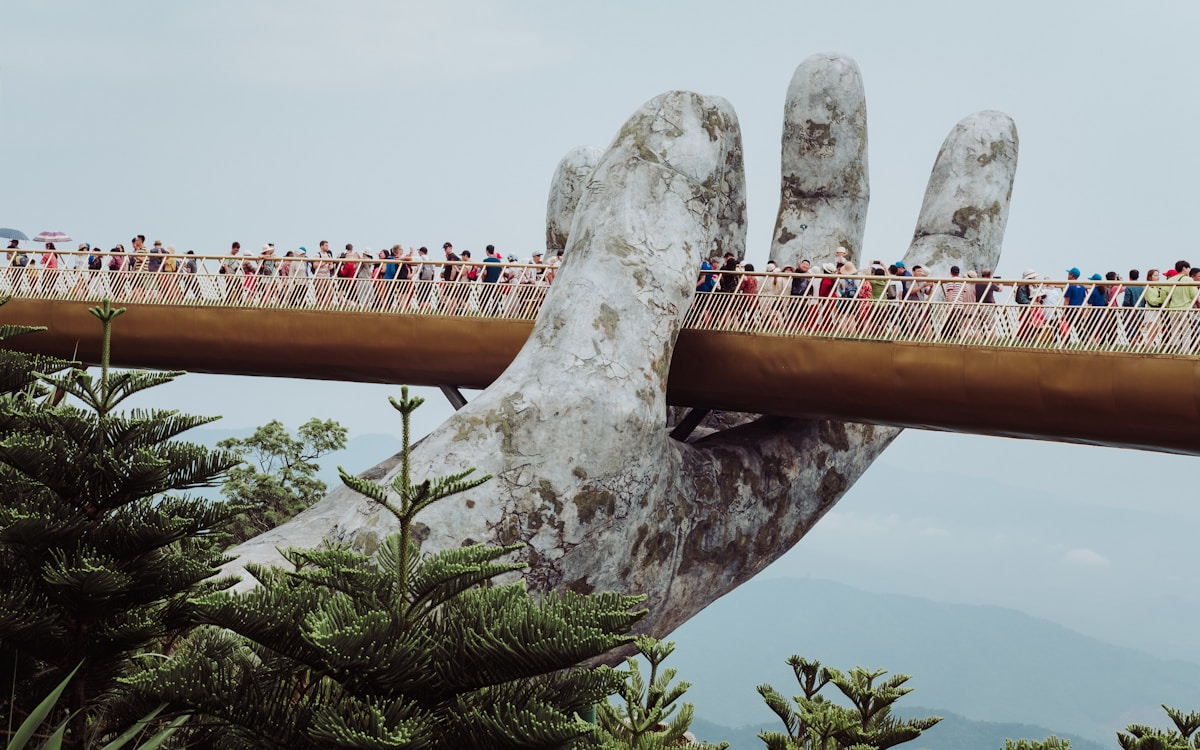
The Golden Bridge — held up by two giant stone hands emerging from mountain mist — has become one of the most photographed structures in Southeast Asia since its opening in 2018. The Bà Nà Hills complex sits at 1,487m elevation, 30km from Da Nang city. A French colonial hill station reinvented as a fantasy resort destination. Day trips from coastal resorts are standard. For official visitor and ticketing information: Bà Nà Hills Sun World
Surfing: Non Nuoc and My Khe Beach
Non Nuoc Beach produces the best surf in Da Nang — consistent beach break, best October–March when northeast swells arrive. My Khe Beach (city beach, north of Non Nuoc) works October–February. Multiple surf schools operate from both beaches; most resorts have equipment rental.
Getting to Da Nang
By air: Da Nang International Airport (DAD) — direct flights from Singapore (2h15m), Bangkok Suvarnabhumi (2h), Seoul Incheon (4h30m), Tokyo Narita (5h), Taipei (2h45m), Hong Kong (2h30m). From Ho Chi Minh City: 1h20m. From Hanoi: 1h10m.
Vietnam e-Visa: Citizens of most countries (including UK, EU, USA, Australia) can obtain a 90-day e-Visa online. Apply at Vietnam Immigration Department — processing typically 3 business days.
By train: The Reunification Express (Hanoi–Ho Chi Minh City) stops at Da Nang — the 16-hour Hanoi to Da Nang segment through mountain tunnels and coastal scenery is one of Southeast Asia's finest train journeys. SE1/SE2 express services have 4-berth soft sleeper cabins at reasonable cost.
When to Visit
February–August: Dry season — best swimming, clear skies, consistent sunshine. February–April sees the lowest rainfall with temperatures 22–28°C. April–August gets hotter (30–35°C) but beach conditions are excellent.
September–November: Northeast monsoon — the highest rainfall period and the season with meaningful typhoon risk. Some resorts partially close in October–November. Not recommended for beach-focused visits.
December–January: Cool, some rain, but generally manageable. Hội An at New Year is atmospheric and less crowded than peak summer.
Explore our guides to Vietnam honeymoon resorts, Phu Quoc luxury resorts, and Singapore luxury hotels for more Vietnam and Southeast Asia inspiration.
Filed under: