Jaipur's palace hotels are among the world's most extraordinary stays — Mughal architecture, rooftop dining, elephant corridors, and centuries of royal heritage. Here's where to stay in luxury in the Pink City in 2026.
# Best Luxury Hotels in Jaipur 2026: Palace Stays in the Pink City
Rajasthan's capital was built pink in 1876 to welcome the Prince of Wales, and it has stayed that way ever since — a city of rose-sandstone palaces, bazaars heaped with block-printed textiles, and maharaja heritage that is simultaneously theatrical and completely genuine. Jaipur is the finest city in India for luxury travellers seeking immersive cultural depth: the palace hotels aren't themed restorations, they are actual royal properties still owned by descendants of the Kachhwaha dynasty who ruled for nine centuries.
Paired with Agra (3.5 hours by road) and Delhi (4.5 hours), Jaipur forms the "Golden Triangle" — India's most visited luxury circuit. But Jaipur alone, approached slowly and staying in its extraordinary palace properties, is worth the flight from anywhere in the world.
Why Jaipur for Luxury Travel
Jaipur is unique because the luxury here has cultural depth that money alone cannot replicate. Staying at Rambagh Palace means sleeping in the former summer residence of Maharaja Man Singh II, whose possessions now form the City Palace museum. The craftsmen in the bazaar below the Hawa Mahal have been making block-printed textiles by hand for 400 years. The elephant handlers at Amer Fort belong to families who have maintained this relationship with the mahouts' guild since the Mughal period.
The Rajasthan Tourism Development Corporation (RTDC) provides comprehensive heritage site passes — worthwhile for visitors planning multiple UNESCO-listed sites.
Best Luxury Hotels in Jaipur
Rambagh Palace — **Editor's Pick**
The most celebrated palace hotel in India and, many would argue, in the world. Rambagh was the official residence of Maharaja Man Singh II until 1957, when his family converted it into India's finest hotel. The 79 rooms and suites retain their original Mughal-influenced architecture — marble jalis (lattice screens), cusped arches, royal gardens, and private zenana (women's quarters) now converted to luxury suites.
The royal rooms: The Maharani Suite (former quarters of the Maharaja's principal wife) and the Maharaja Suite are among the most extraordinary hotel rooms in India — 18th-century murals, silver furniture, and private courtyards with fountain pools.
Dining: Suvarna Mahal is Jaipur's finest restaurant — crystal chandeliers, domed ceilings, and a menu that spans regional Rajasthani royal cuisine (laal maas, dal baati churma) and contemporary Indian.
Polo: Rambagh maintains the only operating polo ground attached to a city hotel in India. Elephant polo demonstrations are staged for guests in the winter season.
Rates: €450–1,200/night. Book directly through TajHotels.com for best room allocation.
SUJÁN Rajmahal Palace, Civil Lines
A rival to Rambagh for those who prefer boutique scale over grand hotel sweep. SUJÁN operates a small collection of extraordinary heritage properties across Rajasthan, and Rajmahal is their Jaipur flagship — a former royal guesthouse that once accommodated visiting heads of state.
What sets it apart: SUJÁN is India's most acclaimed conservation hotel brand, committed to traditional craft revival. Every piece of furniture in Rajmahal was made by artisans from Jaipur's Kumhera and Sanganer craft villages. The tented dining pavilion in the gardens is one of Jaipur's most atmospheric dinner settings.
Conservation angle: SUJÁN's parent foundation funds wildlife corridor preservation in Ranthambore and Jawai — a genuine conservation model, not greenwashing. Guests can arrange day trips to SUJÁN's Ranthambore camp (4 hours from Jaipur) to combine city luxury with tiger safari.
Rates: €380–650/night.
Samode Palace, Samode Village (45 min from Jaipur)
Technically outside Jaipur — 45 kilometres north in the Aravalli foothills — but essential to any complete Jaipur luxury guide. Samode Palace is a 475-year-old Rajput fortress hotel that has been in the Samode Royal Family for nine generations. The painted rooms (Sheesh Mahal) are covered floor-to-ceiling in mirror-work and fresco murals — among the most visually extraordinary interiors in India.
What makes it unique: The setting. Unlike the city palace hotels, Samode is surrounded by desert hills, peacocks, and complete silence. The rooftop candlelit dinner, with views over the illuminated palace and dark desert beyond, is unforgettable.
Day trip option: Visit as a day trip from Jaipur for lunch and palace tour, or overnight for the full experience.
Rates: €300–500/night.
Alila Fort Bishangarh
A 230-year-old hilltop fortress converted by Alila into one of Rajasthan's most dramatic resort experiences — 59 suites within a working fortification, with views extending 30 kilometres across the Aravalli plateau. The conversion is exemplary: ancient ramparts and towers preserved, contemporary interiors with Rajasthani craft elements throughout.
Activities: Rock climbing on the fort's outer walls, falconry demonstrations, village walks to Bishangarh below, and Rajasthani cooking classes with the palace chef.
Rates: €350–650/night. 50 minutes from Jaipur city centre — worth the drive for the setting alone.
Dera Mandawa Haveli, Jaipur Old City
For travellers who want to be inside the Pink City itself — walkable to the Hawa Mahal, Jantar Mantar, and the bazaars. Dera Mandawa is a 15-room haveli (merchant mansion) hotel in the heart of the old city, furnished with antique Rajasthani pieces and managed with genuine hospitality by the owning family.
Why it works: Waking up in the Old City means you can walk to the flower market at 6am, visit the Amber Fort before the tourist buses arrive, and be back for breakfast before 9am. The rooftop has unobstructed views of the Hawa Mahal.
Rates: €120–220/night — exceptional value for the location.
Jaipur Essential Experiences
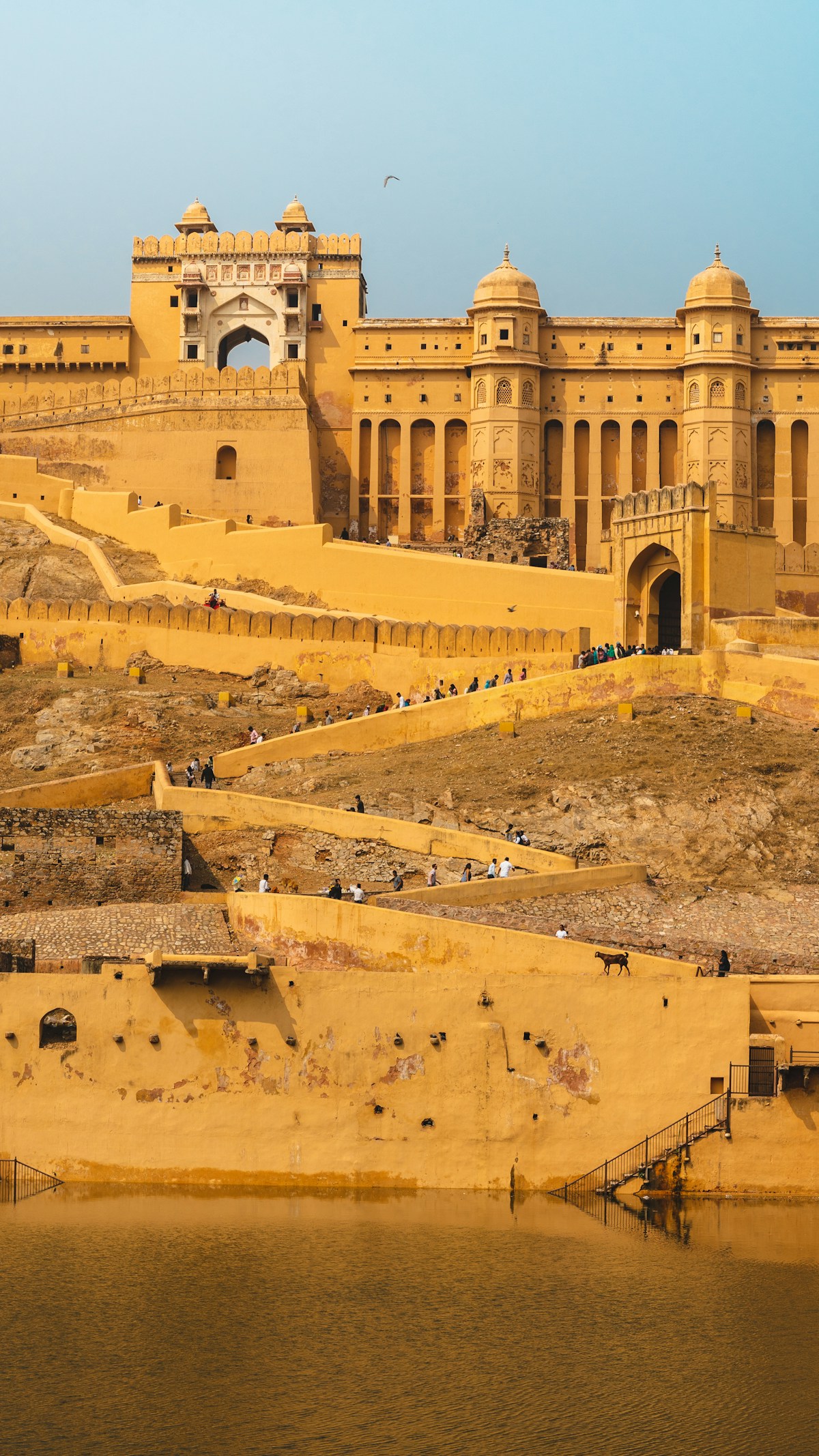
Amber Fort (UNESCO): The 16th-century hilltop palace-fortress is Jaipur's crown jewel — a 20-minute drive from the city, accessible by jeep or on foot. Arrive at 7am for the sound-and-light rehearsals and empty courtyards. The Archaeological Survey of India manages the fort; current entry fees are ₹500 (foreigners).
City Palace: Still the residence of the current Maharaja (27th of the line). The public museum section contains extraordinary Mughal-era paintings, weapons, and royal carriages. The Chandra Mahal (seven-storey palace core) is visible from the courtyard.
Jantar Mantar (UNESCO): The 18th-century astronomical observatory built by Maharaja Jai Singh II — 19 monumental instruments that measure time, predict eclipses, and track celestial bodies with naked-eye accuracy. More impressive than it sounds; hire a guide.
Johari Bazaar & Bapu Bazaar: The old city markets for Rajasthani textiles, block-print fabrics, gemstones (Jaipur is the global centre for precious stone cutting), and lac bangles. Bargaining is expected and enjoyed.
Rajasthani Cooking Class: Every palace hotel offers cooking classes; the best are at Rambagh Palace (royal Rajasthani cuisine) and the smaller Khaana Khazana cooking school in the Old City.
Jaipur Practical Information
Getting there: Jaipur International Airport (JAI) connects directly to Dubai (3.5 hrs), Singapore (via layover), and most Indian metros. From Delhi, the Shatabdi Express train (4.5 hrs) or Gatimaan Express is the preferred luxury ground option — scenic and comfortable.
Climate: October–February is the ideal season — warm days (22–28°C), cool nights (8–15°C), and clear skies. March–May is hot (35–45°C). Monsoon (July–September) brings dramatic skies and green landscapes but some site closures.
Currency: Indian Rupee (INR). ₹1 = approximately USD 0.012. Cards widely accepted at hotels and major restaurants; carry cash for bazaars and auto-rickshaws.
Travel advisory: The UK Foreign Travel Advice for India rates Rajasthan as generally safe for tourism with standard urban precautions.
The Golden Triangle Context
Jaipur is most commonly visited as part of the Golden Triangle — Delhi (capital), Agra (Taj Mahal), and Jaipur (Pink City). The circuit covers three of India's most significant heritage destinations within a 250-kilometre triangle. Private car hire with driver (€60–90/day from Jaipur) is the most flexible option; the Gatimaan Express covers Delhi–Agra in 1.5 hours, and the Shatabdi covers Jaipur–Delhi in 4.5 hours.
*More Indian luxury guides:* Best luxury palace hotels Rajasthan 2026 | Best luxury hotels Delhi 2026 | Best luxury hotels Mumbai 2026
Filed under: